Top Free Online Computer Science courses with Certificates

Computer science isn’t new, but what it looks like is. The computer science skills, languages, libraries, and tools professionals use every day are constantly shifting, now more than ever. It’s a field that demands continuous learning, but that anyone can jump into right away. Opportunity is everywhere and endless.

“What makes computer science really interesting is the rate at which it changes means that no one’s ever really at a disadvantage,” said David Joyner, PhD and executive director of online education for the College of Computing at the Georgia Institute of Technology. Joyner teaches several edX courses and programs, from programming in Python to human-computer interaction, to thousands of students of all backgrounds.

“The range of people we see in our programs is what’s indicative of the amount of opportunity there is and the absence of the requirement for a long formal education history.”

Computers Are Everywhere, You Just Might Not See Them

How we think about and interact with computers has drastically shifted in just a few decades. Computers have evolved from monolithic towers to rectangular blocks on desks to pocket devices we use every day. While they grow in power, they shrink in size and next, you won’t even see them.

“As we go forward, it will be more and more about computers being involved where there are no screens. Computer science is becoming more and more embedded in pretty much every field, and more and more embedded in everyday life,” Joyner said.

In his final weekly column, veteran tech journalist Walt Mossberg echoed this trajectory, writing that the trend towards the “disappearing computer” has the potential to create a new world that’s unrecognizable.

“It’s a radically different way of thinking about tech,” Mossberg wrote. “This is ambient computing, the transformation of the environment all around us with intelligence and capabilities that don’t seem to be there at all.”

Tech-Driven Opportunity Can Level the Playing Field, but Demands You Keep Pace
This new world of ambient computing is flush with opportunity, but driven by rapidly changing technology. The traditional education model alone doesn’t support this pace of change, so professionals must find ways to keep skills sharp and keep up with the latest programming languages, libraries, tools, and ideas.

Modern, modular learning opportunities offer paths for seasoned computer scientists, industry newcomers, and everyone in between to gain the skills they need to advance and build careers.

“It’s not the traditional career trajectory where you have to go to college for four years, go to grad school for three years, get a junior position, and then there’s this ladder. In computer science, it’s constantly learning new things. It does mean that you can’t rest, you can’t get complacent with what you know because it is going to continue changing,” Joyner said.

“You hear some people talk about, ‘if I could go back and do it again, I would do this other major.’ Well, if you majored in accounting 20 years ago and now you’re wishing you had majored in computer science, if you go back and start taking CS classes now, what you’re going to be doing a year from now is going to be the exact same things that you majored in in the first place two years ago, because that’s how fast the deal changes.”

Computer Science is For Everyone

Through online edX courses and on-campus programs, Joyner teaches thousands of students a semester across an increasingly broad range.

“I see people who are just fresh out of undergrad, our oldest graduate from one of our programs was over 65 and was mostly doing it for personal curiosity. There’s a lot of people who work in software who are already aware they need to stay up to date on their skills, working alongside people who didn’t major in computer science and want to transition into computer science, working along with the same people who don’t want to transition into computer science but understand the importance it can have to what their career is,” Joyner said.

“Some of my favorite types of students are those who come in and say, ‘I’m a chemist by trade,’ or ‘I’m a physicist, I’m an astrophysicist, and so much of what we do now is write code that processes results and write code that does this and that. And I don’t want to change careers, but I understand that computer science is important to my career’ — we see a lot of that.”

In addition to diversity of professional background and level, Joyner and others working in computer science recognize the need for the field to be less homogenous, and the impact potential of diversity of thought.

“With all these automation efforts in our lives, humans working in computer engineering will be more important than ever to ensure that our automation reflects our individual, community, and societal values,” said Petra Bonfert-Taylor, professor at the Thayer School of Engineering at Dartmouth College, and Rémi Sharrock, associate professor at Télécom ParisTech at IMT. Together, Bonfert-Taylor and Sharrock teach a Professional Certificate program in C Programming with Linux.

“More than anything, I think as a community we need to draw from a very diverse set of people, both racial, gender, ethnicity, nation of origin, professional experience, personal background, all those kinds of things. Because the design of the systems that we build necessarily is imbued by the assumptions and the beliefs of the people who designed them. Even beliefs we’re not really aware of. Many of the problems we see with technology are because the people who are affected by it are not there on the design team creating it.” Joyner said.

“Practically speaking, it’s important not just because of social good, not just because it’s the right thing to do. We need it because it’s going to have negative effects otherwise. If you feel like you don’t belong to CS, it probably means that we need you. We need our systems to carry forward your background, your true beliefs, your assumptions.”

It’s Never Too Late to Get Started in Computer Science

“It doesn’t really matter that there’ve been people working in the fields for 20 years and you’re just starting out right now. The languages and the libraries that you’ll be using on the job in a few years probably haven’t even been created yet,” Joyner said. “It’s never too late to start because whatever you feel like you don’t know now, it might not even be important in three years. The important thing is to start, so you can start to be able to understand what you need to continue to learn and what you need to keep up with a career.”

It’s never too late to get started in beginning or advancing your computer science career, change jobs and industries, or jump back into the field after a lapse, like edX’s own chief architect Nimisha Asthagiri.

“I had the pleasure of taking off eight years from the industry in order to live a life as a full-time mom and an active community volunteer. When I returned to the workforce, I was inundated with the plethora of new technology, which was overwhelming, not even knowing where to start. But my love for problem-solving and engineering kept me going,” Asthagiri said.

Kickstart Your Learning With Computer Science Courses and Programs for All Levels
On edX, over 760,000 people have enrolled in HTML courses, over 380,000 in C++ courses, over 1 million in JavaScript courses, and over 3 million people in Python courses — and counting.

Whether you’re just starting out or have been a computer scientist for years, join millions of edX learners in committing to keeping your skills up to date and take advantage of all the opportunities this field has to offer. From foundational courses to advanced degrees, find your computer science path at edX.

“Data analytics provides opportunities for computer science to produce evidence-based decisions in our lives, communities, and society. It is an exciting time to be working in computer engineering to make these new developments inclusive and equitable for all humans.” – Bonfert-Taylor and Sharrock said.
Best Cyber Security Courses Online 2020:Free & Paid -Hackers and Developers

cyber security courses

Learn Cyber Security from top-rated instructors. Find the best Cyber Security Courses and path for your level and needs and take your first steps in becoming a cyber security expert . Learn how to Securing Code, Code Auditing,Exploit Development,Malware Analysis and the most relevant op IT security frameworks available to information security tech industry.

Security Fundamentals

In this series, you will expand your knowledge of threats, attacks, and vulnerabilities; security technologies and tools; security architecture and design, identity and access management, risk management, and cryptography.

RELATED TOPICS
Threats,Security Architecture, Security Design, Identity Management Access Management, Risk Management, Cryptography

What you will learn

  • How to analyze indicators of compromise and determine the type of malware
  • How to compare and contrast types of attacks and explain threat actor types and attributes
  • How to explain penetration testing and vulnerability scanning concepts
  • How to explain the impact associated with types of vulnerabilities
  • How to install and configure network components, both hardware and software-based, to support organizational security
  • How to use appropriate software tools to assess the security posture of an organization
  • How to troubleshoot common security issues
  • How to analyze and interpret output from security technologies
  • How to deploy mobile devices securely
  • How to implement secure protocols
  • How to explain use cases and purpose for frameworks, best practices and secure configuration guides
  • How to implement secure network architecture concepts and secure systems design
  • How to explain the importance of secure staging deployment concepts
  • How to explain the security implications of embedded systems
  • How to summarize secure application development and deployment concepts
  • How to summarize cloud and virtualization concepts
  • How to explain how resiliency and automation strategies reduce risk
  • How to explain the importance of physical security controls
  • How to compare and contrast identity and access management concepts
  • How to install and configure identity and access services
  • How to implement identity and access management controls and how to differentiate common account management practices
  • How to explain the importance of policies, plans and procedures related to organizational security
  • How to summarize business impact analysis concepts
  • How to explain risk management processes and concepts
  • How to follow incident response procedures
  • How to summarize basic concepts of forensics
  • How to explain disaster recovery and continuity of operation concepts
  • How to compare and contrast various types of controls
  • How to carry out data security and privacy practices
  • How to compare and contrast basic concepts of cryptography and how to explain cryptography algorithms and their basic characteristics
  • How to install and configure wireless security settings
  • How to implement public key infrastructure

Pre-requisites

This path does not require any prior knowledge or experience.

Beginner

In this section, you will learn how to identify security threats, attacks, vulnerabilities, technologies, and tools.

Threats, Attacks, and Vulnerabilities for CompTIA Security+

Technologies and Tools for CompTIA Security+


Intermediate

This segment of the Path discusses security architecture and design while also exploring identity and access management.

Architecture and Design for CompTIA Security+

Identity and Access Management for CompTIA Security+

Advanced

This section encompasses the more advanced fundamentals topics, which include managing security risks, cryptography, and public key infrastructure (PKI).

Risk Management for CompTIA Security+

Cryptography and PKI for CompTIA Security+


2. Security for Hackers and Developers

Security for Hackers and Developers lays the foundation for anyone interested in creating secure software and systems, or anyone interested in hacking computer systems. Upon completion of this path, you will have learned how to discover, analyze, fix, as well as exploit vulnerabilities. Join on this cyber security learning journey, and help make your projects and networks safer.


Programming in Cyber Security!

Before we start a new semester, let’s look at the first semester of the study programme of Cyber Security from my perspective. Recently I’ve been getting a lot of questions related to the programming as such. People are mainly concerned whether they can study Cyber Security with a lack of programming knowledge.

For those who don’t know me, I graduated from Software Engineering and currently I am a 1st year MSc Cyber Security student and also working as an iOS Engineer in TalTech. I can say that I do programming on a daily basis and I hope that with this post I will answer to the most frequently asked question: “can I study without programming skills?”

There is a short and a long answer. If I need to start with the short answer, that’s easy: YES! But for the long answer, please stick with me.


Programming is a skill that can be acquired easily. Yes, really. There are tons of resources for anyone who wants to learn programming. There are a lot of websites that are full of content and even sometimes 100% free.

Yes, you can survive in the cyber security field without programming. But, you shouldn’t. If you ask why, let me put down some points for you:

  1. Reading source code is important: in most of the cases, you need to find a needle in the haystack and sometimes you need to find that needle in the source code. You will be mainly dealing with software vulnerabilities and learning programming will increase your code reading ability and also give you more aspects to search for.
  2. Automating small things will save tons of time: programming is a life-long skill. You can use it nearly everywhere. Of course, there are already tons of products and software to use that would save us much time. Instead of a regular programming flow, if you think out of the box, you will see more possibilities where you can make small automating scripts and gain the advantage of programming. For example, you can write your own script to select the courses at the beginning of the semester. Sounds cool, right?
  3. If there is no such thing for that job, why not to create your own: thanks to other engineers and developers all around the world, there are a lot of tools for us to use and test on systems according to our use cases. But let’s assume that we are dealing with a very weird edge case where no existing tool can be applied properly. With the help of programming that you learned and improved during the years, you can develop a tool or even an exploit on your own. Then other people around the world can use this particular tool or exploit that you have developed, which is amazing!

To sum up, you can survive without programming but you will still rather learn how to do it. Programming can be learned and will be a life-long skill for you. In addition to you studies in cyber security, it may open new ways or introduce your newer horizons.

If you liked this post, some claps and sharing it will be very helpful to spread the word 🙂

Serverless Web Application with Lerna and Webpack

In this Guide we will learn how to write Serverless services in Monorepo style.

When I tried to write a solutions combine Serverless, Webpack and Lerna together, I can’t find any good guide how to do this, then, after implementing it I feel like I want to share my finding with the community,

What is Lerna?

Lerna,a tool for managing JavaScript projects with multiple packages, mostly used for Monorepo, Monorepo is beneficial strategy to keep all your repositories in a one global repository, contains all the common infrastructure and build tools, while each sub ‘package’ contains a different business project.

So if I have different services, I’ll keep all of them in one repository, each one in a different package.

You have a file structure that looks like this:

package.json
packages/
package-1/
package.json
package-2/
package.json

My root package.json contains some common dependencies like aws-sdk and some dev-dependencies like webpack

{
  "name": "root",
  "private": true,
  "dependencies": {
    "aws-sdk": "^2.531.0",
    "request-promise": "^4.2.5",
    "request": "^2.88.0"
  },
  "devDependencies": {
    "express": "4.17.1",
    "lerna": "^3.19.0",
    "serverless-webpack": "^5.3.1",
    "webpack": "^4.40.2",
    "webpack-cli": "^3.3.9"
  }
}

Read more about Lerna and it’s feature in Lerna github.

Let’s serverless it:

Serverless framework gives us the ability to deploy a serverless application (GCP,AWS,AZURE)

A basic example of yml file defining a Lambda:

service: MyService

provider:
  name: aws
  runtime: nodejs12.x

package:
  exclude:
    - node_modules/**

functions:
  myFunction:
    handler: index.myFunction

Let’s bundle it, Adding webpack to the party:

We obviously won’t want to deploy the full code to AWS, and we may want to use webpack to bundle it into one huge index file.

In order to do that I use serverless-webpack plugin

All the work needed, is just adding it to the serverless file:

service: MyService

provider:
  name: aws
  runtime: nodejs12.x

package:
  exclude:
    - node_modules/**

plugins:
  - serverless-webpack
functions:
  myFunction:
    handler: index.myFunction

And the index file wii look like this:

module.exports.myFunction = async (event, context) => {

    //doing all stuff needed :)
};

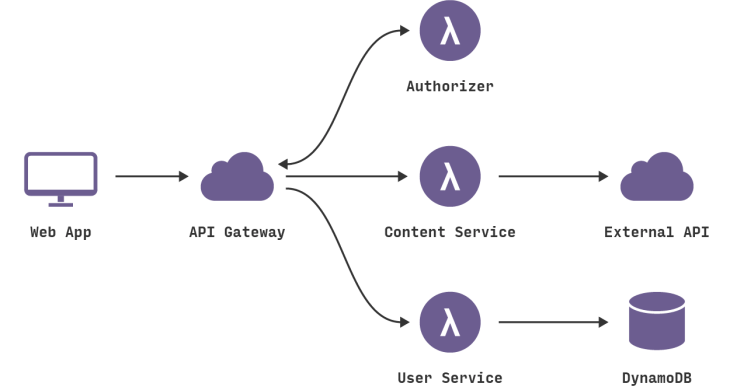
We mention that package is a business service unit, and it can be split to multiple Lambdas, for example UserService, can be split to 3 Lambdas for create, delete and update.

index.js will be like:

module.exports.createUser = async (event, context) => {

    //doing all stuff needed :)
};


module.exports.updateUser = async (event, context) => {

    //doing all stuff needed :)
};

module.exports.deleteUser = async (event, context) => {

    //doing all stuff needed :)
};

With its equivalent serverless.yml

service: UserService

provider:
  name: aws
  runtime: nodejs12.x

package:
  exclude:
    - node_modules/**

plugins:
  - serverless-webpack
functions:
  createUser:
    handler: index.createUser
  updateUser:
    handler: index.updateUser
  deleteUser:
    handler: index.deleteUser
What can I achieve from managing all my packages in the same repo?

Sure, I can have one yml file contains my VPC configuration, security groups, subnet ids, common environment variables and more, and all of them in a one root yml file. this can be referred from any serverless.yml:

provider:
  name: aws
  stage: prod
  runtime: nodejs12.x
  vpc:
    securityGroupIds: ${file(../../.root.yml):securityGroupIds}
    subnetIds: ${file(../../.root.yml):subnetIds}

  environment:
    ${file(../../.root.yml):environment}

And the root.yml:

securityGroupIds:
  - "sg-xxxxx"
subnetIds:
  - "subnet-xxxxx1"
  - "subnet-xxxxx2"
  - "subnet-xxxxx3"
environment:
  KEY1: value1
  KEY2: value2

Conclusion

In this Guide we implement monorepo contains some services, each service can contains multiple lambdas, and each lambda is deployed using serverless framework, and we set some common configuration in the root folder to affect all sub packages.