What is Load Balancing? How Load Balancing Works

Load balancing is the process of distributing incoming network traffic across multiple servers to ensure that no single server is overwhelmed with too much demand. This optimizes the responsiveness and efficiency of a network, ensuring that each user gets the best possible experience.

Load balancers play a critical role in managing and maintaining the health and efficiency of networks, especially in high-traffic environments. They help in scaling the capacity of applications, enhancing reliability and availability, and ensuring the smooth operation of websites and services.

How Load Balancing Works:

  1. Distribution of Requests:
    At its core, a load balancer receives incoming traffic and distributes the requests across multiple servers based on various algorithms. These algorithms can be as simple as round-robin (where each server gets a turn) or more complex ones that consider server load, geographic location, response times, or even custom rules.
  2. Server Health Checks:
    Load balancers routinely check the health of each server. If a server is not responding, has crashed, or is returning errors, the load balancer will stop sending traffic to that server until it is healthy again.
  3. SSL Termination:
    For secure websites using SSL/TLS, the load balancer can handle the process of encrypting and decrypting user traffic, offloading this CPU-intensive task from the application servers. This is often referred to as “SSL termination” because the SSL session “ends” at the load balancer.
  4. Session Persistence:
    Some applications require that a user continues to connect to the same backend server. Load balancers can maintain “session persistence” (or “sticky sessions”) by directing a user’s requests to the same server during a session.
  5. Layer 7 Load Balancing:
    Beyond simple distribution based on server or connection counts, modern load balancers can make decisions based on HTTP headers, cookies, or data within the application message itself, often referred to as Layer 7 load balancing.
  6. Scalability:
    When traffic demand increases, new servers can be added to the pool, and the load balancer will start sending them traffic. Similarly, if a server needs maintenance, it can be removed without disrupting the users.
  7. Protection Against DDoS:
    Many advanced load balancers offer features to mitigate Distributed Denial of Service (DDoS) attacks, ensuring that malicious traffic doesn’t cripple the network.

Types of Load Balancers:

  1. Hardware Load Balancers: Physical devices optimized to distribute traffic.
  2. Software Load Balancers: Run on general-purpose operating systems and can be more flexible than hardware solutions.
  3. Cloud-Based Load Balancers: Offered by cloud hosting service providers, scaling automatically as traffic demands.

In conclusion, load balancing ensures that a network can handle a large number of requests without any single server becoming a bottleneck, improving both performance and reliability. Whether you’re running a large e-commerce platform, a streaming service, or any high-traffic application, load balancing is a critical component in maintaining a stable and responsive infrastructure.
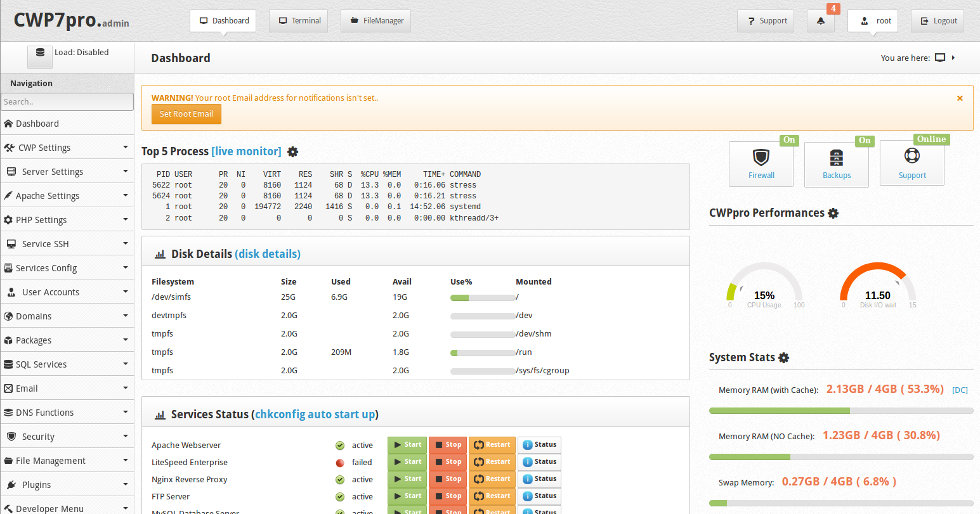

CentOS Web Panel Review – Features, Pros & Cons

CentOS Web Panel, commonly referred to as CWP, is a free web hosting control panel specifically designed for the CentOS operating system. Its main objective is to offer an easy-to-use interface to manage servers, making the task of web hosting and server maintenance more straightforward and less time-consuming.

Features of CentOS Web Panel:

  1. Intuitive User Interface: CWP comes with a user-friendly GUI, making it easier for even non-technical users to manage their servers.
  2. One-click App Installations: The Softaculous auto-installer allows for one-click installations of numerous apps, including WordPress, Joomla, and many more.
  3. Server Monitoring: Offers in-built tools for real-time monitoring of server resources, such as CPU, RAM, and disk usage.
  4. Security: Features Mod Security, CSF Firewall, and other tools to ensure server security.
  5. Free SSL: CWP provides a free SSL certificate for the panel, hostnames, and user domains, ensuring encrypted and secure connections.
  6. PHP Selector: Allows for the switching between different PHP versions according to website requirements.
  7. Database Management: Integrated database management tools, including phpMyAdmin, for efficient management of MySQL databases.
  8. Email Management: Offers a built-in mail server with popular tools such as Roundcube for webmail access.
  9. DNS Management: Provides an integrated DNS server with an easy-to-use DNS zone editor.
  10. Backup and Restore: Automated backup solutions, along with easy restoration functionalities.

Pros of CentOS Web Panel:

  1. Cost-Effective: Being a free tool, CWP provides a host of functionalities without any licensing cost.
  2. Security: Comes bundled with various security modules and tools that offer robust protection against potential threats.
  3. Active Community: A growing community of developers and users ensures regular updates, bug fixes, and shared knowledge.
  4. Customization: Provides a flexible environment, allowing users to customize configurations according to their needs.

Cons of CentOS Web Panel:

  1. Specific to CentOS: CWP is tailored for CentOS, meaning users cannot use it for other Linux distributions.
  2. Learning Curve: While designed to be user-friendly, newcomers to web hosting might find certain features a bit complex.
  3. Performance Issues: Some users have reported occasional performance hiccups, especially when dealing with high traffic sites.

Why Choose CentOS Web Panel?

  1. Budget-Friendly: If you’re starting and are on a tight budget, CWP offers a wealth of features for free, reducing operational costs.
  2. Comprehensive Management Solution: From server monitoring to database management, CWP covers a wide range of server-related tasks under a single interface.
  3. Regular Updates: The active community ensures that the software is regularly updated, keeping up with industry standards and security protocols.
  4. Security: With in-built firewalls and security modules, CWP ensures that your server and hosted websites remain secure from potential threats.

Conclusion:

CentOS Web Panel is an excellent choice for those looking to dive into server management without incurring high costs. Its feature-rich environment, combined with robust security features, makes it a viable choice for hosting websites, especially on CentOS servers. However, as with any tool, it’s essential to understand its functionalities fully and be aware of its limitations. Investing time in getting familiar with CWP can lead to a seamless and efficient web hosting experience.

Looking for best web and WordPress hosting read this guide:

Happy deploying !

7 Small Business Tech Trends for 2023

In today’s rapidly evolving digital age, small businesses must stay ahead of the curve to remain competitive. Embracing technological advancements can not only boost efficiency but also provide a unique edge in the market. Here are seven tech trends for 2023 that every small business should be aware of:

Small Business Tech Trends

Remote Work Technology & Hybrid Offices

Even as the world adapts to post-pandemic realities, the demand for flexible work arrangements persists. Advanced collaboration tools, virtual reality meetings, and cloud-based project management software are making remote work more efficient and widespread. Small businesses are moving towards hybrid office models, blending in-office and remote work.

AI-Powered Customer Service

Artificial Intelligence (AI) has made significant strides in enhancing customer service. Chatbots, personalized shopping experiences, and AI-driven customer insights are becoming the norm. For small businesses, this means more efficient customer interaction with the potential for increased sales and loyalty.

Sustainable Technology

Eco-friendliness is no longer just a buzzword; it’s a business imperative. Green technologies, whether they involve energy-efficient operations or sustainable supply chains, are attracting conscious consumers. Small businesses adopting these practices are likely to see both reputational and financial benefits.

Blockchain Beyond Cryptocurrency

While blockchain is often associated with cryptocurrencies, its applications go beyond just digital currency. For small businesses, blockchain can provide secure, transparent transactions, smart contracts, and even aid in supply chain verification.

Edge Computing

As IoT (Internet of Things) devices proliferate, there’s an increasing need for data processing at the source rather than in a centralized data center – this is known as edge computing. For small businesses, this means faster processing times, reduced latency, and the ability to handle large amounts of data more efficiently.

Augmented Reality (AR) in Retail

Augmented Reality is redefining the retail experience. Whether it’s virtual try-ons, AR-guided store navigation, or interactive product displays, integrating AR can offer customers a more immersive shopping experience. For small retailers, this is an opportunity to combine the online and offline worlds in innovative ways.

Cybersecurity & Data Privacy Enhancements

As digital operations expand, so do threats from cybercriminals. Small businesses are increasingly investing in advanced cybersecurity measures, recognizing the importance of protecting customer data and their own intellectual property. Furthermore, with stricter data privacy regulations worldwide, ensuring compliance has become paramount.

Conclusion:

The future is bright for small businesses willing to integrate and adapt to these tech trends. By understanding and leveraging these advancements, small enterprises can streamline operations, improve customer experiences, and set themselves up for sustained success in an increasingly digital world.

For those looking to elevate their small business’s online presence, understanding hosting is crucial. Dive into reddit’s in-depth discussion on small business hosting : Which are the best web hosting for small business? To discover the best practices, options, and insights to ensure your digital foundation is rock solid. Don’t miss out!