Metaverse Division Reports Q4 Operating Loss of $4.279B

Meta Reality Labs, the VR division of Facebook, reported a fourth-quarter operating loss of $4.279 billion and revenues of $727 million for the quarter.

This was the company’s largest loss yet for its metaverse division, but stock prices are going up in after-hours trading as the results were better than expected. The company launched the Meta Quest Pro, an enterprise high-end version of its headset, for $1,500 during the quarter.

Meta is investing in the metaverse, the universe of virtual worlds that are all interconnected. They raised the prices of their Meta Quest 2 VR headsets by $100 each and expect Reality Labs losses to continue into 2023. They are investing in the Meta Quest 3 family for consumers, the Meta Quest Pro for enterprises, and other long-term areas that aren’t being described yet. Those areas include new computing platforms, glasses and software.

Mark Zuckerberg announced that Meta is shifting its focus to developing a software and social platform, while also taking a $4.2 billion restructuring charge related to the termination of some office-space leases, redesigns of datacenter projects, and severance for employees laid off in Q4. Another $1 billion in restructuring costs will come in 2023.

In Q4, Meta’s net income was $4.652 billion with revenue of $32.165 billion and 2.96 billion daily active users. This is a decrease in net income from the previous year of $10.285 billion and an increase in daily active users of 5%. Monthly active users were 3.74 billion on December 31, up 4%.

After the close of trading, Meta’s stock price rose 17.75% to $180.30 per share. Although the company did not meet its net income expectations, it surpassed analysts’ predictions for revenue and other key metrics. Specifically, revenues totaled $31.53 billion (versus the expected $30.86 billion), Facebook daily active users were 2 billion (compared to the anticipated 1.98 billion) and family of apps daily active users totaled 2.96 billion (in comparison to the forecasted 2.92 billion).

At the end of Q4, meta had 86,400 employees, 11,000 of whom were kept on payroll due to severance costs. These individuals will no longer be counted going forward. In a call, CFO Susan Li stated that the macroeconomic environment continues to cause uncertainty and instability in advertising demand.

Read More:


OpenAI releases “ChatGPT Plus”

OpenAI, the AI startup unicorn, is now monetizing its popular AI chatbot released in November by offering businesses a suite of services such as natural language processing and machine learning solutions.

OpenAI is monetizing its popular ChatGPT AI software by launching a new subscription plan called ChatGPT Plus that starts at $20 per month and provides users with faster response times and priority access to new features.

OpenAI recently released a free tool that is intended to identify automatically generated text, which has caused some controversy due to the potential use of AI to write homework assignments such as articles and essays. The effectiveness of this tool is yet to be determined.

ChatGPT will be free to use, but customers who pay for the Plus version will get priority access, faster response times, and early use of new features. The Plus version is currently only available in the US .

OpenAI will be inviting people from its waitlist to use its Plus platform in the coming months and plans to expand availability to additional countries and regions soon.

Read More:

OpenAI unveiled AI Text Classifier

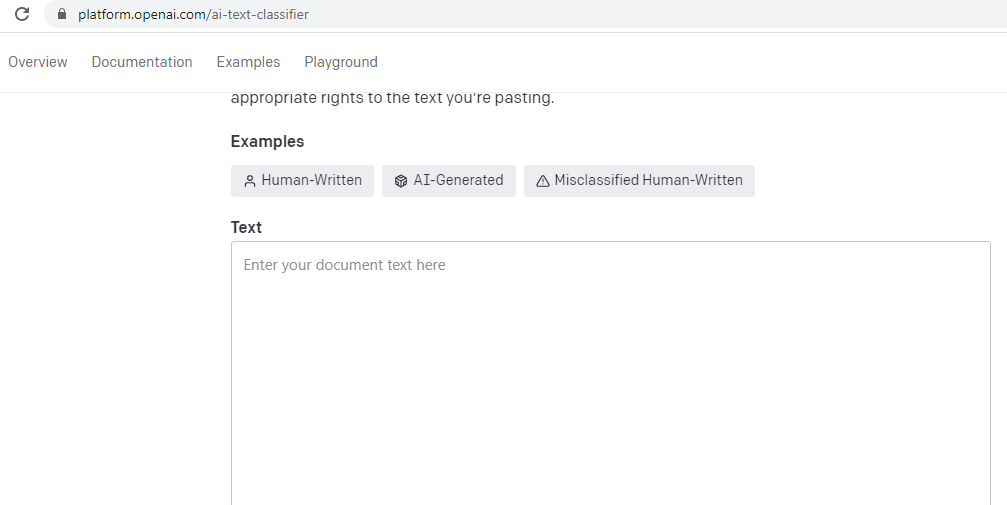
On Tuesday, OpenAI unveiled AI Text Classifier(link), which is designed to detect text written by artificial intelligence versus human-generated words. This latest tool comes in the wake of criticism surrounding the ChatGPT text generator that was released in November 2022.

OpenAI AI Text Classifier
                                                                                     OpenAI AI Text Classifier


Despite its popularity, the chatbot has been accused of plagiarism and has been barred from some schools. Additionally, there have been reports that students used ChatGPT to compose essays for homework assignments.


OpenAI’s AI Text Classifier is an intriguing model, trained on a vast amount of text from the web. It has been fine-tuned to identify whether a piece of text was created by an AI or not – more specifically, it was trained with 34 models from five different organizations, including OpenAI itself. This included text from Wikipedia, websites collected from Reddit links and human demonstrations for a previous OpenAI system.

However, there is a chance that some AI-written content may have been mistakenly classified as human due to the sheer volume of AI-generated content online.

OpenAI’s Text Classifier cannot process just any text; it requires a minimum of 1,000 characters or 150-250 words. Unfortunately, the classifier does not have the capability to detect plagiarism, which is a major drawback considering AI-generated text has been proven to repeat information from its training data.

Additionally, OpenAI has warned that accuracy may suffer when working with texts written by children or in languages other than English as its dataset primarily consists of English content.


OpenAI reported that the classifier incorrectly labeled human-written text as AI-written 9% of the time, but I did not encounter this mistake in my testing due to the small sample size. Additionally, OpenAI stated that the Classifier has a 26% rate of correctly identifying an AI text as likely being AI-written (true positives).


In the future, they aspire to share more advanced techniques and make their classifier even better at detecting AI-generated content such as English text written by adults. Text classification through machine learning is becoming ever more crucial for diverse purposes like email spam filtering and sentiment classification; thus, this tool to detect AI-generated text is a significant stride forward.

OpenAI’s commitment to releasing a GPT-Classifier, a free detection tool for AI-text generation, is important as more people use these tools. The GPT-Classifier has its limitations but it is still seen as a reliable way to detect AI-generated text.

Read more: